
Recently, Professor Zhang Bo from Fudan University(Chairman of SHINE-HYDROGEN (Shanghai) New Energy Technology Co., Ltd.)The team has once again published important research results in the top journal Nature Communications in the field of energy materials. This study proposes an innovative "strong bonding" modification strategy for iridium based catalysts, which are the core of proton exchange membrane (PEM) water electrolysis for hydrogen production. This significantly improves the activity and durability of the catalysts, injecting new momentum into the industrialization of PEM water electrolysis technology.
PEM Water Electrolysis technology is considered an ideal technology for coupling with renewable energy to produce green hydrogen due to its high efficiency, fast response, and good hydrogen purity. However, its industrialization process has always been constrained by core catalyst materials: the widely used iridium based catalysts still have room for improvement in their activity and long-term stability, and the high cost also restricts their large-scale application.
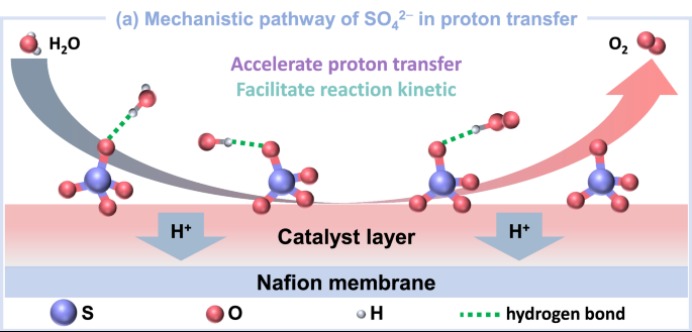
Faced with this challenge, Professor Zhang Bo's research team at Fudan University has taken a different approach, no longer limited to adjusting the structure of traditional catalysts, but focusing on precise regulation of their surface chemical environment. The research team used a clever surface grafting technique to anchor sulfonic acid groups in a strong covalent bond on the surface of commercial iridium based catalysts, creating a stable catalytic microenvironment.
This strategy is like putting a stable functional coat on the catalyst. Research has confirmed that this' outer garment 'not only effectively accelerates proton transfer during the reaction process, enhances reaction kinetics, but also remains stable for over 1000 hours at industrial grade current densities, greatly delaying performance degradation caused by loss of active components. After this simple modification of the catalyst, it was found to be effective at 3.0 A · cm-2Under high current density, the electrolysis voltage is significantly reduced, and the performance is significantly better than that of unmodified commercial catalysts.
Of particular importance is that this method has a simple process, is easy to prepare on a large scale, and can improve the stability of catalyst ink. This has positive practical significance for the batch and consistent production of industrial grade membrane electrodes.
As the leader of SHINE-HYDROGEN Energy, Professor Zhang Bo has always led the team to stand at the forefront of technology, committed to solving core scientific and engineering problems in the hydrogen energy industry. This research achievement is another milestone achieved by the team in overcoming the contradiction between the cost and performance of electrolytic water catalysts, demonstrating a clear path from basic research to industrial application.
In the future, SHINE-HYDROGEN Energy will continue to rely on its strong research and innovation capabilities to accelerate the development and application of high-performance and long-life electrolytic water catalysts, helping China maintain its leading advantage in the green hydrogen energy track.
Original link: